

For years, premiumisation was the driving force behind value growth in alcoholic beverages. Today, signs of depremiumisation are raising questions, concerns and even panic. In this three-part series, we explore what is really happening, what it means for brands and how to respond strategically rather than react defensively.
I- THE CHANGING RULES OF PREMIUM

What depremiumization is, and why you need to understand it.
One of marketing’s fundamental jobs is to build value: create differences consumers care about and turn them into preference, willingness to pay and ultimately profitable growth.
For more than two decades, premiumization has been one of the beverage alcohol industry’s most successful ways of doing exactly that. Consumers traded up, portfolios moved upwards, and value grew faster than volume. SOMETHING IS CHANGING.
Consumers haven’t stopped wanting the good stuff, i.e. premium. But signs show they are becoming more selective about when, where and why they will pay more. Trading up is becoming less linear, established price ladders less predictable, and adding another premium proposition is no longer an automatic route to growth. For marketers, that’s important. Premiumization is moving from a default growth strategy to a strategic choice.
In this three-part series, we look at how marketers should respond to this new reality:
- how to recognise and diagnose depremiumization;
- how to decide whether to defend a premium, reshape it or give some of it up;
- how to build more value when premiumization remains the right strategy.
So… what exactly is depremiumization?
DEPREMIUMIZATION IS NOT SIMPLY TRADING DOWN
We simply define depremiumization as a weakening of consumers’ willingness to pay an established premium—or to continue trading further up.
Trading down is one manifestation. But there are others. Consumers may stay with the core proposition rather than move to the reserve. Or buy their preferred premium brand only when promoted. Or purchase it less frequently. Or reserve premium for fewer occasions. Or move expenditure towards another category, format or proposition that offers a more compelling value equation.
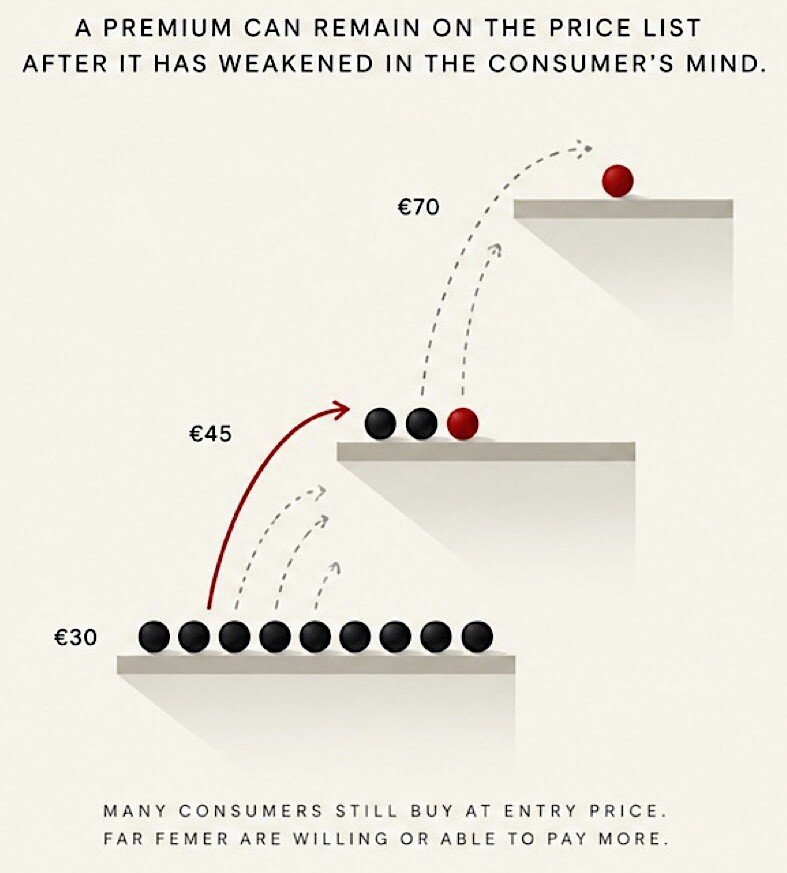
The important distinction is between premium price and willingness to pay a premium. A €45 bottle can remain priced at €45 long after consumers have started questioning whether the difference from the €30 bottle is worth €15.
THE CHANGE WAS EASY TO MISS
Covid initially pushed behaviour in the opposite direction. Premiumization accelerated in many markets as consumers treated themselves to better bottles at home.
Even in early 2022, premium-and-above spirits remained remarkably strong. But by late 2022, IWSR was already identifying “selective uptrading”: consumers continued to premiumize in some places while economising elsewhere.
By the first half of 2023, premium-and-above volumes across 20 major markets remained 11% above 2019—but were only 1% ahead of the previous year.
Today, the evidence increasingly points NOT to the disappearance of premium, but to more selective premiumization: consumers choosing more carefully when, where and why they will pay more.
DON’T DIAGNOSE EVERYTHING AS DEPREMIUMIZATION
A decline in premium sales is a symptom, not a diagnosis. The same -10% can result from very different problems. Imagine your €45 whisky declines 10%.
- If the whole whisky category is declining at a similar rate while your relative position remains stable, you may have a CATEGORY problem. Consumers are buying less whisky—not necessarily rejecting your premium.
- If consumers still value your €45 proposition but increasingly cannot accommodate it within their spending, you may have an AFFORDABILITY problem. The premium may still be valued, but purchasing power is constraining their ability to pay for it.
- If other €45 whiskies are holding or growing while yours declines, you have a BRAND problem. Consumers are still willing to pay the category premium—just not for you.
- But if consumers remain in the category, your brand remains competitive, yet they increasingly stay at €30 rather than trade to €45, wait for the €45 bottle to be promoted, or buy it less often, you may have a genuine DEPREMIUMIZATION problem. The additional value offered is no longer consistently generating the additional willingness to pay.
The distinction is fundamental:
- CATEGORY: Do consumers still want this type of product?
- AFFORDABILITY: Can they currently afford to pay the premium?
- BRAND: Do they still choose us at this price?
- DEPREMIUMIZATION: Do they still see enough additional value to pay more?
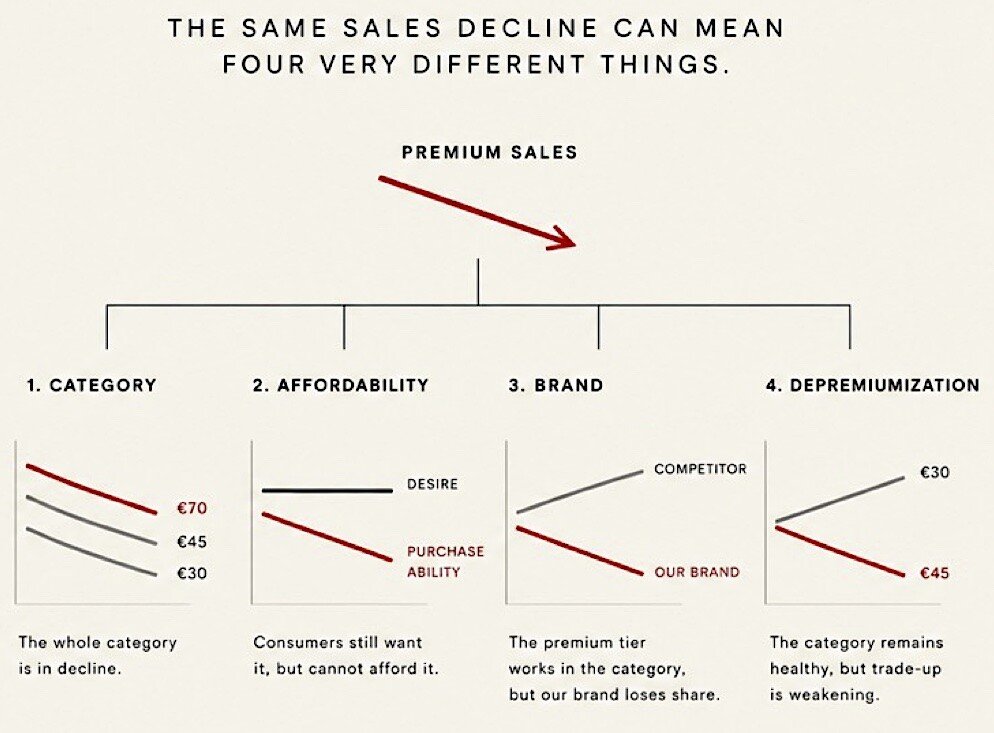
Each diagnosis points towards a different response. That means looking beyond topline sales to understand where value is being lost: category demand, brand preference, ability to pay—or willingness to pay the premium.
The first management question is not : How do we defend our premium? It is: Are consumers still willing to pay us more—and if not, why not?
Because before deciding whether to defend, reshape or even give up some of that premium, we first need to understand what is actually changing.
II- ALTERNATIVES WAYS TO CREATE VALUE BEYOND PREMIUMIZATION
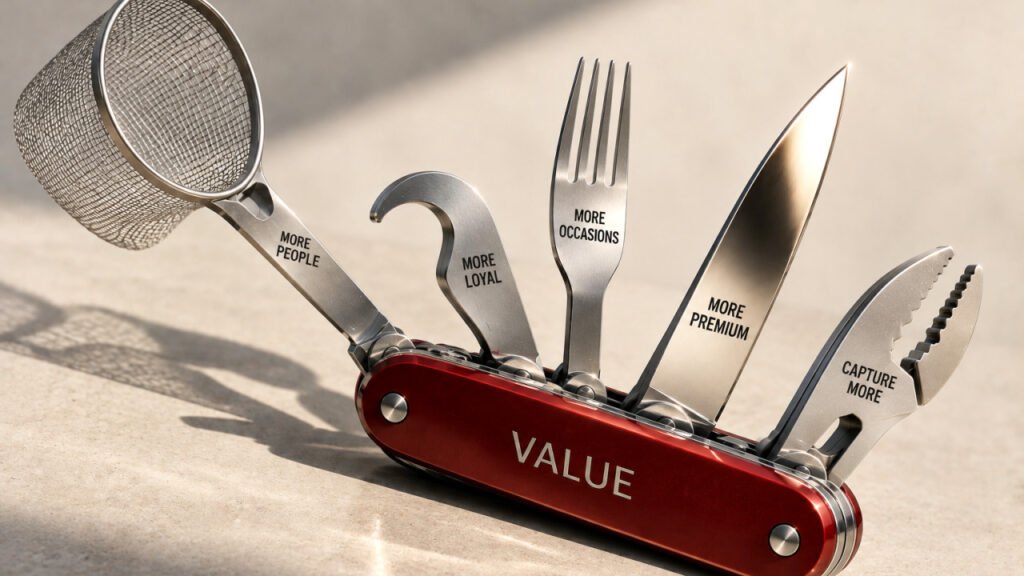
There are five ways to create value when moving consumers up is not the only answer
In the first section, we argued that premiumization is moving from a default growth strategy to a strategic choice. That matters because premiumization is not the objective. Value creation is.
For years, one of the beverage alcohol industry’s most powerful growth equations was straightforward: create more perceived value, justify a higher price and encourage consumers to trade up.
It still works. But it is only one way to create value.
1. MORE PEOPLE
Can we create more value by recruiting more consumers?
Sometimes penetration is worth more than premium: stronger distribution, greater accessibility, recruitment—or removing a price barrier limiting the brand’s potential.
Diageo’s recent experience with whisky in the UAE illustrates the principle. After repositioning prices and strengthening distribution, Diageo reported that VAT 69 sold in 20 days the volume it had previously sold in a year at the old price. Sometimes less value per bottle creates more value overall.
2. MORE LOYAL
Can we win a greater share of consumers’ existing choices?
For alcohol, the objective is obviously not to encourage people to drink more frequently. But a brand can become more frequently chosen: stronger preference, repeat purchase and a greater share of consumers’ existing repertoire.
The opportunity isn’t more drinking. It’s more of the choices already being made.
3. MORE OCCASIONS
Can the brand play a valuable role in more moments?
Gifting, aperitif, dinner, celebration, cocktails, at-home or on-trade: different occasions create different needs—AND different willingness to pay more.
This has a bigger portfolio implication. A portfolio organised only as Standard → Premium → Super Premium →Prestige answers how much will consumers pay?
An occasion-led portfolio also asks when, where and why will they choose us? Perhaps portfolios need to work across occasions as well as up price ladders.
4. MORE PREMIUM
Can we create enough additional perceived value to deserve a higher price?
Premiumization remains a powerful value engine. The job isn’t simply to charge more, but to create product, brand or experiential value consumers recognise and are willing to pay for.
And it works hand-in-hand with occasions. The same consumer may choose differently for an everyday drink, dinner, celebration or gift. Consumers don’t necessarily trade up permanently. They trade up for particular choices and occasions.
5. CAPTURE MORE
Are we capturing the value we’ve already created?
Look at realised price versus RSP. Promotional investment versus incremental NSV. Price gaps, mix, customer economics and margin. This may sound like commercial hygiene, but substantial brand value can leak through poor promotional and commercial execution.
Before creating more value, stop leaking the value you already have.
And this isn’t Marketing’s job alone. Sales and Revenue Growth Management are fundamental to turning consumer value into commercial value.
THE VALUE EQUATION
These five engines work together. More occasions can generate trade-up. Better distribution can recruit more people. Greater loyalty can improve mix. Better commercial execution captures more of everything Marketing creates.
So instead of automatically asking: How do we move consumers up?
Ask: Where are our strongest sources of value, and how should we combine them?
MORE PEOPLE. MORE LOYAL. MORE OCCASIONS. MORE PREMIUM. CAPTURE MORE.
Premiumization remains one powerful answer. But it is one part of a broader value strategy. And when premiumization is the right answer, its playbook needs to evolve too.
III- PREMIUMIZATION: THE NEW PLAYBOOK

How to find, build, recode and orchestrate premium value
In the first article, we argued that premiumization is moving from a default growth strategy to a strategic choice. In the second, we widened the lens: premiumization is only one of several ways to create value.
But what if premiumization is still the right strategy?
Imagine we have a successful €45 12-year-old Scotch and believe there is an opportunity at €60. The old playbook might start by asking what we can add: more age, more craft, more rarity, more packaging, more story. Perhaps the new playbook should start somewhere else: What would actually make this brand worth €15 more?
1. DEFINE THE VALUE
What is genuinely worth paying more for?
The objective is not to identify more premium cues. It is to find a valuable difference capable of generating incremental willingness to pay.
Before creating the €60 Scotch, understand what could justify the premium. Perhaps consumers value a distinctive maturation, greater rarity, a particular provenance or an experience the €45 expression cannot deliver. The answer will vary by category, brand, consumer and occasion. So, what gives your product the right to charge more?
2. BUILD THE PROPOSITION
What do we actually create to deliver that value?
Liquid, finish, bottle, pack, name, story and experience can all contribute. But simply accumulating premium features doesn’t necessarily create premium value.
Our €60 Scotch needs to offer something consumers recognise as meaningfully more valuable than the €45 expression—not simply more elaborate. Build the difference, not the decoration.
3. RECODE THE PREMIUM
How do we make that value legible today?
Now imagine the €60 proposition genuinely delivers, but we express it through the same familiar vocabulary of age statements, crests, gold foil, tasting notes and craftsmanship claims as everyone else.
The underlying sources of value may still be powerful. The way we encode them can change.
That means thinking about
- CLARITY: making the reason to pay more immediately understandable;
- CURATION: prioritising the strongest evidence;
- RELEVANCE: connecting value to contemporary expectations;
- DISTINCTIVENESS: using proprietary rather than vs. premium codes and
- DEPTH: making the proposition easy to grasp but rewarding to explore.
This isn’t an argument for minimalism. It’s an argument for legibility.

4. ORCHESTRATE THE MIX
Does everything reinforce the €60 proposition?
Premiumization doesn’t stop with the product or its identity. Our €60 Scotch can have a compelling liquid, proposition and design—but if it is routinely promoted to €49, distributed indiscriminately, given the same POS as the €30 expression and served without distinction in the on-trade, the mix starts dismantling the value Marketing worked to create.
Price, portfolio, distribution, promotion, activation, communication and experience all need to reinforce the same value equation.
Every decision around the proposition either reinforces or discounts the premium signal.
IN CONCLUSION
The old premiumization question was: How do we move consumers up?
The better question may now be: How do we earn the right to charge more?
FIND THE VALUE. BUILD THE PROPOSITION. RECODE THE PREMIUM. ORCHESTRATE THE MIX.
Premiumization hasn’t disappeared. But simply adding more premium is no longer enough. The new playbook is about building a coherent and relevant premium value system. If premiumization is still your strategy, perhaps it’s time to examine how you’re doing it.