

In a series of six topics, we explore how to spot emerging flavour opportunities, understand what makes flavours meaningful, look beyond trends, rethink line extensions, approach RTD innovation and uncover what consumers really seek. This approach leverages the Flavour Foresight Foundry (FFF) tool and challenges conventional thinking to inspire more relevant, differentiated and commercially meaningful innovations.
I – THE HIDDEN LOGIC BEHIND FLAVOUR INNOVATION

… or why flavour trends often begin long before flavours themselves appear.
Most innovation decisions today rely on sales data, trend reports, social listening, or competitor launches. These are valuable inputs, but they are fundamentally backward-looking. Meanwhile, product development often requires 12–24 months from idea to shelf. The risk is obvious: brands launch products into a market that has already moved on.
The question is therefore not simply: What flavours are trending today? The more useful question may be: What will make flavours relevant when products actually reach the market?
This is the thinking behind the Flavour Foresight Foundry (FFF) developped by Brand Reveal: a structured approach designed to anticipate emerging flavour territories before they become visible market trends. The core idea is simple. Flavours are not merely sensory experiences. They also carry meaning.
Consumers rarely choose flavours based purely on taste. Flavours often communicate identity, mood, social intent and occasion. Citrus may signal freshness and sociability. Dark chocolate may evoke sophistication and reward. Warm spices can suggest comfort and ritual. These meanings influence expectations long before consumers consciously articulate them.
But flavour meanings do not exist in isolation. They evolve with culture. And culture is intimately linked to occasions. As lifestyles change, so do emotional needs and drinking occasions. Smaller home gatherings may replace large nights out. Self-reward rituals may become more important. Premiumisation may shift from visible luxury to quieter forms of personal indulgence…
In this context, flavour trends are often consequences rather than causes. The logic can be expressed simply:

FFF was developed around this causal structure.
The process begins with strategic inputs rather than ingredient lists. Category context, market realities, target consumers, channels, constraints and business objectives create the starting point. AI-assisted exploration is then used to scan emerging signals and patterns. These are translated into consumer motivations, flavour meaning systems and occasion logic before becoming flavour territories and innovation platforms.
The objective is not to predict specific flavours. It is to identify the conditions under which flavours become relevant. The approach often produces unexpected but coherent directions, which in turn fuel in informed conversations, ideas and decisions.
For example,
In premium whisky, an exploration focused on recruiting new drinkers did not lead toward sweetness or flavour simplification. Instead, it identified a growing desire for composed authority and quieter confidence. This translated into a flavour territory built around precision and structure: orchard fruit brightness, subtle citrus lift and controlled oak expression.
In chocolate liqueurs, the opportunity was not “more chocolate”. Emerging signals pointed toward dessert becoming experiential and socially shareable. This created a flavour territory closer to liquid patisserie: layered chocolate systems inspired by premium desserts rather than simple sweetness.
In flavoured wines, an approach to recruiting younger urban drinkers would not lead toward sweetness or wine complexity. Instead, social signals point towards a growing desire for effortless sociability and light emotional decompression. This would translate into flavour territories built around freshness and ease: crisp orchard fruit, soft rosé berries, coastal citrus brightness and restrained tropical lift.
These examples illustrate an important distinction. FFF is not a trend report generator, nor an AI flavour machine producing random ideas. FFF is a structured system translating cultural signals into flavour hypotheses that can then be debated, refined and stress-tested.
Because ultimately, successful innovation rarely depends on finding the next fashionable ingredient. It depends on understanding why certain flavours will matter before everyone else notices them.
II – BEYOND MANGO: WHAT MAKES FLAVOURS MATTER?

… or why flavours increasingly behave like ideas rather than ingredients.
Everybody loves a new flavour trend. A few years ago it was pink pepper. Then yuzu seemed to appear everywhere. Functional ingredients quickly followed. Today, mango appears to be enjoying its moment in the sun. RTDs, flavoured spirits, alcohol-free propositions and energy drinks increasingly feature it. And there is nothing wrong with that.
The issue is elsewhere. During innovation discussions, comments often sound familiar:
- “Mango is hot right now.”
- “Consumers want tropical flavours.”
- “Competition already launched one.” etc…
Fair enough. But perhaps there is a more interesting question hiding underneath. Why? Why should consumers suddenly wake up wanting mango? Why not peach? Why not orange? Why not one of the thousands of flavour possibilities available?
Because people rarely become attached to ingredients themselves. They become attached to what ingredients do.
Take coffee. Most of us probably did not enjoy our first espresso. Mine certainly was not a transformative experience. It felt bitter, slightly aggressive and frankly a bit unnecessary. Yet millions of people eventually learn to love coffee. Not because of taste alone. Coffee can mean:
- ritual
- adulthood
- energy
- identity
The liquid stays relatively similar. The meaning becomes much larger. Flavours increasingly behave in similar ways. This becomes particularly interesting when looking at mango. Mango suddenly appears across categories that, from a liquid perspective, have relatively little in common.
But perhaps they are not selling the same liquid. Perhaps they are selling the same feeling. From a semiotic point of view, mango increasingly appears to carry signals such as:
- Escape A small holiday without needing airport security.
- Positivity Brightness and optimism.
- Indulgence Pleasure without becoming heavy.
- Accessible discovery Something slightly adventurous without becoming intimidating.
That last point may matter. Consumers increasingly want novelty. But they do not necessarily want uncertainty. Mango behaves a little like a passport for comfortable exploration. Slightly more interesting than orange, but less demanding than tamarind, gentian or ingredients requiring a small educational program on the back label.
This is where blindly following ingredients can become dangerous. If ten brands suddenly launch mango because a trend report says it is growing, they may all end up doing exactly the same thing. Different bottle. Same story.
During flavour projects, we repeatedly noticed that teams often move directly from ingredients toward ideas while skipping the more interesting question underneath. This became one of the reasons for developing the Flavour Foresight Foundry (FFF): to connect cultural signals, motivations and flavour meaning systems before trends become obvious.
Take mango itself:
- Signal: Mango increasingly appears across categories.
- Motivation: Consumers increasingly seek positivity, comfort and moments of escape.
- Occasion: Casual social moments and low-effort rewards.
- Flavour Territory: Bright optimism and accessible discovery.
Mango then simply becomes one possible expression. Because the mistake is often starting with the ingredient and hoping meaning will follow. People rarely invite flavours into their lives for flavour alone. They invite what those flavours represent. Mango simply reminds us of something larger: Flavours become stronger when they stop behaving like ingredients and start behaving like ideas.
III – FOUND A TREND? SO WHAT NOW?

… or why visible trends are often symptoms rather than causes.
Media and social platforms love trends. Every year brings a fresh collection of reports announcing the next big thing: adaptogens, savoury cocktails, botanical ingredients, alcohol-free drinks, premium RTDs or whichever ingredient suddenly becomes everybody’s new best friend.
Trend reports are useful. The issue is elsewhere. Because spotting trends is rarely the difficult part. Understanding what to do with them is. Imagine sitting in an innovation meeting and hearing:
- “Bitterness is growing.”
- “Consumers increasingly want natural products.”
- “Alcohol moderation is booming.”
- “Everybody is moving into RTDs.”
Fine. Now what? Should we launch something immediately? Redesign the portfolio? Change communication? Ignore it altogether? Because not every trend deserves attention.
And perhaps more importantly, not every visible trend is necessarily the real story. Across categories, we increasingly noticed discussions concentrating around visible things:
- products
- ingredients
- formats
- categories
Meanwhile, much less time was being spent discussing what sits underneath. This became increasingly problematic because innovation itself is rarely immediate.
Product development often requires 12–24 months before reaching shelves. Yet many decisions are based on signals that frequently appear relatively late in the cycle: sales data, trend reports and competitor launches.
The result can become surprisingly predictable. Everybody arrives at the same destination. At roughly the same time. With roughly the same idea.
This is one of the reasons for developing the Flavour Foresight Foundry (FFF): to help move beyond visible trends and understand the motivations and cultural shifts that often precede them.
One practical FFF lens starts with four simple steps:
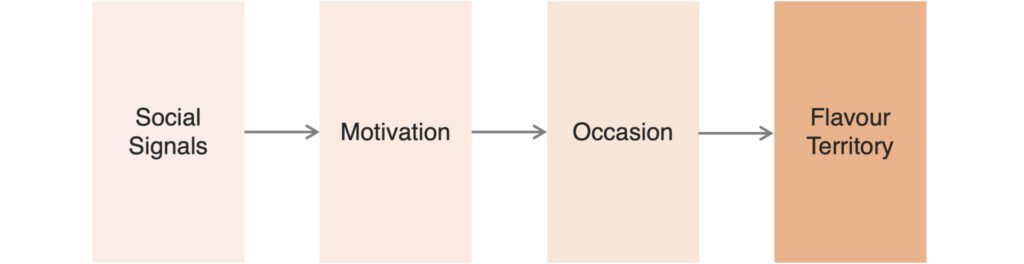
Let’s take bitterness as an example. A few years ago, bitterness might simply have been considered a taste profile. Today it increasingly appears in cocktails, aperitifs, coffee and more adult drinking moments. Looking only at the flavour itself may create a rather simple conclusion: “Consumers increasingly like bitter tastes.”
But perhaps the story is elsewhere.
- Signal: Growth of bitter profiles.
- Motivation: Consumers seek distinction, sophistication and rewarding experiences.
- Occasion: Early evening rituals and more intentional social moments.
- Flavour Territory: Structured complexity and adult refreshment.
Now the picture starts changing. Bitterness itself may not be the trend. Bitterness may simply be one expression of a broader movement. Think of trends a little like theatre. Most people notice the actors on stage. But very little happens without what sits behind curtains:
- the script
- the lighting
- the set
- the direction
Visible trends are often the actors. The underlying forces are usually writing the story. Because once you understand the forces underneath, you gain options.
Trends may change names. Ingredients may come and go. Categories may evolve. Motivations tend to move more slowly. And sometimes the most valuable opportunities are not hidden in the trend itself. They are hidden one layer below it.
IV – BEFORE YOU PUT YOUR BRAND IN A CAN…

… or a little RTD sanity check before entering new occasions.
Everybody seems to want an RTD. Every few weeks there appears to be another announcement: whisky RTDs, tequila RTDs, premium cocktails in cans, wine-based propositions, alcohol-free RTDs and increasingly sophisticated ready-to-drink experiences.
And the enthusiasm is understandable. RTDs continue to attract consumers, create visibility and open new routes to market. They feel convenient, increasingly premium and often easier to access than more traditional categories.
So naturally, innovation discussions frequently begin with a relatively simple question:
“Should our brand enter RTDs?”
Fair question. But perhaps not the right one. Because putting your brand into a can is not always innovation. Sometimes it is simply fear of missing out wearing a rather attractive aluminium jacket. The issue is not RTDs themselves.
The issue is often rushing toward the solution before checking whether the opportunity actually exists. RTD discussions frequently seem to move quickly from:
“RTDs are growing.”
to:
“Which flavour should we launch?”
while skipping a few important questions in between.
This became one of the reasons for developing the Flavour Foresight Foundry (FFF): to help move from visible opportunities toward more structured decisions. One practical FFF lens starts with four questions:
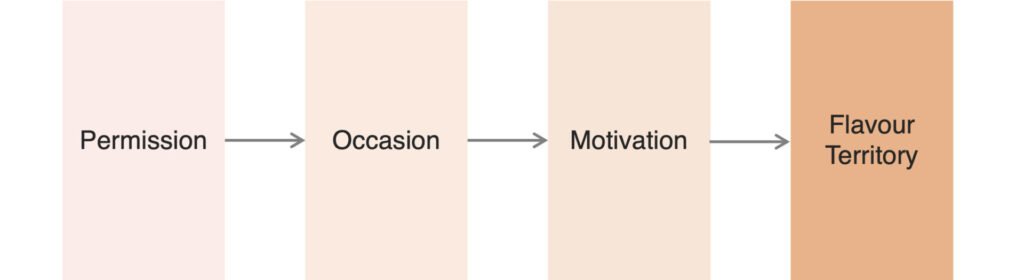
Let’s unpack them.
1. Does the brand have permission? Consumers can be surprisingly flexible. But they also have a rather good radar for things that feel forced. Some brands naturally travel across occasions and formats. Others feel more rooted in specific rituals. Neither is right or wrong. But assuming every brand can stretch indefinitely may become risky.
2. Which occasion are we entering? An after-dinner sipping spirit entering RTDs is not simply changing packaging. It may be entering:
- beaches
- festivals
- after-work moments
- convenience occasions
- outdoor gatherings
The can changes. The behaviour changes too.
3. Which consumer motivation are we serving? Convenience? Moderation? Discovery? Social connection? Because RTDs are not only products. They frequently solve specific jobs.
4. Which flavour territory supports the transition? Flavour can help open doors. Lighter profiles can create accessibility. Brighter profiles can support refreshment and energy. But flavour should support the move. Not become the move.
Think of brands a little like dinner guests. Some people seem comfortable in almost every room. Others become memorable precisely because they shine in very specific situations. There is nothing wrong with either. Problems usually start when somebody arrives at the wrong party.
Interestingly, many RTD failures may not result from poor liquids. Apart from weak launch support, they may simply come from brands entering new occasions without bringing along a reason to belong there. Not every brand needs to attend every party.
Some belong everywhere. Others become stronger precisely because they know where they belong. Because growth opportunities are not always found in adding new occasions. Sometimes they are found in choosing the right ones.
V – SO YOU WANT TO LINE EXTEND WITH FLAVOURS?

… or why flavour innovation should begin with strategic intent before ingredients.
In the previous article, we explored the conditions to examine before stretching your brand.
Everybody loves flavour innovation. Retailers often ask for it. Consumers enjoy novelty. Marketing teams like launching something new and, if we are honest, seeing a new SKU arrive on shelves is usually more exciting than discussing portfolio architecture.
So one flavour becomes two. Two become five. Soon enough somebody mentions blood orange, salted caramel, watermelon-chili or some unusual botanical and suddenly everybody in the room has an opinion. Then things often become slightly messy.
Because after a few rounds of discussion, conversations start sounding familiar:
- “I prefer this one.”
- “Consumers probably want sweeter profiles.”
- “Competition already has something similar.”
- “Can we make it feel more premium?”
And before anybody notices, the flavour itself has become the strategy. Which is a bit like discussing curtain colours before deciding where the house will be built.
The issue is not flavour innovation. The issue is often where teams begin. Because flavours should frequently be the end of the discussion rather than the beginning. In line-extension projects, we repeatedly noticed teams moving directly from market observations toward ingredients while skipping a few important questions in between.
This became one of the reasons for developing the Flavour Foresight Foundry (FFF): to help translate strategic questions into more coherent innovation opportunities. Because innovation should not normally start with flavours. It should start with intent.
One practical FFF sequence starts with a simple progression:
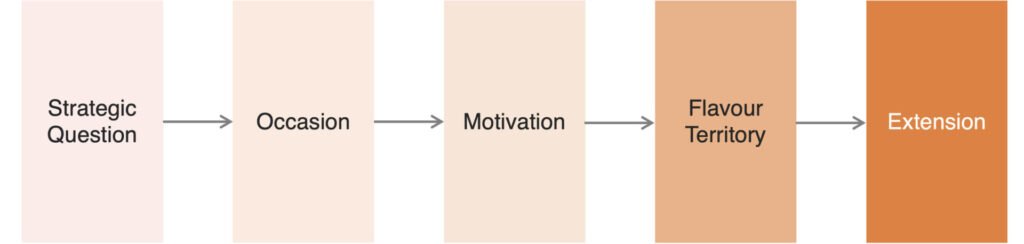
Let’s start at the beginning.
What job should this extension actually perform?
Surprisingly, the answer often remains unclear.
At Brand Reveal, we see four common roles flavour extensions play.
1. Recruit new consumers. Some categories feel serious, traditional or difficult to approach. The role here is not necessarily to change the brand itself, but to make entry easier.
2. Increase frequency. Some extensions simply create more reasons to purchase and consume. Summer editions frequently play this role.
3. Enter new occasions. Sometimes the objective is not new consumers but new moments. A spirit trying to enter aperitif occasions may require very different flavour territories than one designed for after-dinner rituals.
4. Premiumize. Flavours can also create perceptions of value and craftsmanship. Complexity, rarity or more acquired profiles often contribute here.
Notice something interesting. We still have not selected a flavour. Because flavour is often the consequence rather than the starting point.
Think of coffee for a moment. If coffee brands only asked consumers what flavour they preferred, many people might answer vanilla, chocolate or caramel. Yet some of the most successful coffee propositions remain bitter, complex and occasionally demanding. Because consumers are not only buying flavour. They are buying something around it:
- energy
- comfort
- ritual
- identity
Flavour simply becomes one expression of a larger idea. Growth alone therefore does not automatically equal fit. Innovation can sometimes resemble a supermarket trolley. Add enough things and eventually something interesting may happen.
But stronger portfolios rarely emerge through accumulation. They emerge through intention. Because flavour extensions tend to work best when they answer a question before they answer a taste.
VI – WE DONT NEED NEW FLAVOURS

… or why flavour innovation is often solving emotional problems disguised as ingredient discussions.
Consumers often say they want new things. Retailers ask for novelty. Marketing teams search for the next flavour trend. Every few months another report announces the rise of some new ingredient, botanical or flavour direction suddenly becoming impossible to ignore. And the excitement is understandable. Newness creates attention. It signals movement. It reassures teams that something fresh is happening.
Yet consumers rarely wake up thinking: “I hope somebody invents a new botanical profile today.”
People usually want something else. They may want:
- relaxation
- sociability
- reward
- confidence
- …
Flavours simply are one way of expressing those emotional motivations.
Take tea for a moment. Very few people begin their lives genuinely craving bitterness, tannins or vegetal dryness. Yet tea became one of the largest emotional beverage systems in the world. Not simply because of taste. Tea gradually became associated with:
- calm
- pause
- ritual
- mindfulness
- …
The flavour itself was only part of the equation. The emotional and cultural meaning surrounding it became much larger than the sensory profile alone. The same thing increasingly happens across alcoholic beverages.
Other examples… Bitterness today often signals:
- sophistication
- discernment
- intentionality
- adult refreshment
Tropical flavours frequently signal:
- emotional escape
- optimism
- low-effort pleasure
- accessible discovery
Chocolate increasingly behaves less like simple sweetness and more like:
- crafted indulgence
- self-reward
- experiential dessert culture
- social treat rituals
Even lighter orchard fruit or citrus profiles increasingly appear in drinks expressing:
- composure
- precision
- quiet sophistication
- effortless sociability
This is where many innovation discussions become slightly misleading. Teams frequently debate:
- mango versus peach
- blood orange versus yuzu
- sweetness versus dryness
- floral versus herbal
while the more important question often remains underneath: “What emotional problem is this drink actually trying to address?”
Perhaps flavour innovation works a little like psychology. If somebody feels anxious, emotionally exhausted or disconnected, the solution is not simply “say something comforting”. The response only works if it addresses the underlying emotional tension correctly. Flavours may behave in surprisingly similar ways. Consumers rarely search for ingredients in isolation. They often search for emotional outcomes:
- comfort
- reward
- control
- sociability
- …
A flavour becomes relevant when it symbolically answers the right emotional need at the right cultural moment. Which may explain why certain flavour systems suddenly spread across multiple categories simultaneously.
The ingredient itself is often not the real story. The emotional tension it resolves usually is. This became one of the reasons for developing the Flavour Foresight Foundry (FFF). FFF was built around a relatively simple idea: Flavour relevance often begins upstream from flavour itself. Instead of beginning with ingredients, the process starts by exploring:
- cultural shifts
- changing social rituals
- evolving drinking occasions
- emerging emotional needs
- new forms of identity and reward
These are then translated into flavour territories carrying symbolic meaning. Because if consumers increasingly seek:
- composed control
- bounded indulgence
- effortless sociability
- cognitive decompression
- quiet sophistication
then flavour systems will eventually evolve around those needs too.
This is also why blindly copying visible trends often becomes risky. By the time an ingredient becomes obvious, many brands may already be telling exactly the same story.
- Different bottle.
- Different label.
- Same emotional proposition.
Perhaps successful flavour innovation is therefore not really about inventing new flavours at all. Perhaps it is about recognising emerging emotional needs early enough… Before they become visible on shelves.
Because ultimately, consumers rarely invite flavours into their lives for flavour alone. They invite what those flavours allow them to feel, express or become.
The Flavour Foresight Foundry (FFF) is a proprietary AI-powered innovation and strategic intelligence tool developed by Brand Reveal to transform emerging cultural signals into actionable opportunities. Combining human strategic expertise with AI-assisted exploration, FFF helps brands uncover flavour territories, recruit new occasions and build coherent innovation platforms.
If you are exploring line extensions, flavour innovation, RTDs or future growth opportunities, we would be happy to exchange ideas.